Subscribe To


 Posts
All Comments
Posts
All Comments
Friday, January 7, 2011
New Year, New Life
Okay, so I mentioned in my last post that 2010 was a little disappointing for me in some ways. I think partly because I'm used to being really busy, doing so many things all the time, always in the midst of some means to and end of bettering my life. Nursing school, fixing up an old house, etc. This year most of those things slowed down and I had a lot of time on my (odd) days off to become a little depressed about my new, frustrating and disappointing job and its effects on my whole life, and the uncertain direction in which my life was going. This new year, 2011, I want to change that. Over the next few weeks/months I will be unveiling my new plan for my life. I don't know that I will see a huge change in my career (the biggest stress in my life right now) in 2011, but at least I will hopefully be on my way to finding something that I love in which I can still use my education and background. So I started with a change in the look of my blog! Changes in 2011...let's see them! What are you going to change in your life in this new year?


2010: My Year in Review
2010 was an interesting, if challenging, year. Challenging because of the challenges, but also because for the first year in a long time, I don't really feel like I have much to show for the challenges. Through the last half of my 20s, I tried to do at least one new, exciting thing each year that I hadn't done before and could be proud of. I don't feel like that really happened in 2010. So, I'll rededicate myself this year to making my 30s about accomplishments again. But for now, here's 2010.
Baby sitting my nieces a bit and watching them grow has been so fun. Looking forward to welcoming a new nephew this year, that will even up the score on my mom's side a little!


Annual trip to St. George in February. Always a winner. We also went on a cruise that month, blogged about that here.

Went to Girls' Camp for the first time as an adult. Now THAT was interesting. And fun. And, I was glad it was over by day 4. I never realized how much work the leaders put into camp. I think all I did was cook for 4 days! We had a good time though.
Speaking of camp, I spent most of 2010 as a Young Women leader. I learned a lot, and really gained from it, including some great friendships. Yes, I eventually got called to YW again in my new, reorganized ward. Most of the same girls, some new, and new leaders to work with.
A few more home updates. We did some redecorating in the bedrooms, including finishing the room in the basement (I'll have to post a picture of that later) and finished the backyard. I wish I had taken a picture of the backyard while it was still green and beautiful - it looked great! We had a great garden too, so I'll post a picture of some of the things we grew instead.


We took an awesome trip to San Francisco that included seeing my childhood homes and elementary school, time with friends/family, riding our bikes from the Ferry Building to the Golden Gate bridge, across, and back, plus an extra 8-mile ride along the bay on the way back after getting on the wrong ferry, seeing Wicked, eating at the Cliff House, walking in Golden Gate Park, eating lots of sourdough bread, and our car hitting 100,000 miles on the way home.


We also hiked Timpanogos during the summer. It seemed to be the height of wildflower season, and very beautiful. My knees prevented me from getting to the VERY top, but we made it pretty close.


2010 was also a year for change with family. I mentioned above how I appreciated spending time with my nieces, one of whom was born in 2010. But I also lost my Uncle Fred in July and my Grandma in October. Very sad, but the funerals were a wonderful opportunity to celebrate their lives and reconnect with extended family. My grandma's passing was especially emotional - I was very close to her and pretty much had her near my whole life. All of her daughters were present at her passing, and most of the grandchildren were able to make it to the funeral. We had fun celebrating her life by making a video with photos from her life and visiting the old homes she lived in around Salt Lake City.


My Grandma and her life were an inspiration to me. I especially loved seeing her old homes, as I always love old things and I'm a sucker for nostalgia and all things meaningful. A few weeks after we went to look at and photograph the homes, Chase and I were leaving our house one day for a walk. Just as we were walking down the driveway, two men approached us to ask us if they could take a picture of our house, because it was the house their mother grew up in. They also pointed out the house down the street that their father grew up in. Of course, we told them to take all the photos they wanted. I was glad to be able to do that for someone after all the people that let us take pictures of their homes in memory of our grandma. And I love living in an old house in a historic area, just blocks from where my grandma grew up. I can imagine her childhood there, and now I can imagine the one that happened in my very own house 80-something years ago!
Finally, I celebrated my Golden Birthday - 31 on the 31st! - in October. One of the highlights of my year, because it supposed to be the best year of your life right? Oh, how I've waited for this! If you know me at all, you know I'm kind of obsessed with dates (plus the fixation on meaningful, nostalgic things mentioned above). From the moment I was told of this tradition, I waited for this birthday to happen! My sisters experienced their golden birthdays early in adolescence - 12 and 15 - but I would be the oldest one could possibly be to celebrate this amazing birthday! Finally, the long-awaited day arrived, and I couldn't have asked for a better day. Chase and I went to Las Vegas and stayed at Treasure Island for the weekend. For my birthday dinner, we went to Max Brenner, an amazing restaurant in Caesar's Palace that specializes in CHOCOLATE! What could be better? After spending an hour or two there and becoming thoroughly drunk on love and chocolate, we went back to our hotel to see Cirque Du Soleil's Mystere. After the show, the hotel gave us free sparkling cider (we opted out of the free champagne they offered) and we had a toast in our room. We also enjoyed some hiking at Red Rocks and some shopping that weekend.


Also in 2010: Chase became a full-time teacher at Legacy Preparatory Academy, he started his Master's program in Special Ed at Weber State, I did some more canning (I even canned pickles all by myself), I became an avid reader of Feminist Mormon Housewives, and we had a great holiday season spending time with friends and family. Here's to a great year in 2011!
Baby sitting my nieces a bit and watching them grow has been so fun. Looking forward to welcoming a new nephew this year, that will even up the score on my mom's side a little!


Annual trip to St. George in February. Always a winner. We also went on a cruise that month, blogged about that here.

Went to Girls' Camp for the first time as an adult. Now THAT was interesting. And fun. And, I was glad it was over by day 4. I never realized how much work the leaders put into camp. I think all I did was cook for 4 days! We had a good time though.

Speaking of camp, I spent most of 2010 as a Young Women leader. I learned a lot, and really gained from it, including some great friendships. Yes, I eventually got called to YW again in my new, reorganized ward. Most of the same girls, some new, and new leaders to work with.
A few more home updates. We did some redecorating in the bedrooms, including finishing the room in the basement (I'll have to post a picture of that later) and finished the backyard. I wish I had taken a picture of the backyard while it was still green and beautiful - it looked great! We had a great garden too, so I'll post a picture of some of the things we grew instead.


We took an awesome trip to San Francisco that included seeing my childhood homes and elementary school, time with friends/family, riding our bikes from the Ferry Building to the Golden Gate bridge, across, and back, plus an extra 8-mile ride along the bay on the way back after getting on the wrong ferry, seeing Wicked, eating at the Cliff House, walking in Golden Gate Park, eating lots of sourdough bread, and our car hitting 100,000 miles on the way home.


We also hiked Timpanogos during the summer. It seemed to be the height of wildflower season, and very beautiful. My knees prevented me from getting to the VERY top, but we made it pretty close.


2010 was also a year for change with family. I mentioned above how I appreciated spending time with my nieces, one of whom was born in 2010. But I also lost my Uncle Fred in July and my Grandma in October. Very sad, but the funerals were a wonderful opportunity to celebrate their lives and reconnect with extended family. My grandma's passing was especially emotional - I was very close to her and pretty much had her near my whole life. All of her daughters were present at her passing, and most of the grandchildren were able to make it to the funeral. We had fun celebrating her life by making a video with photos from her life and visiting the old homes she lived in around Salt Lake City.


My Grandma and her life were an inspiration to me. I especially loved seeing her old homes, as I always love old things and I'm a sucker for nostalgia and all things meaningful. A few weeks after we went to look at and photograph the homes, Chase and I were leaving our house one day for a walk. Just as we were walking down the driveway, two men approached us to ask us if they could take a picture of our house, because it was the house their mother grew up in. They also pointed out the house down the street that their father grew up in. Of course, we told them to take all the photos they wanted. I was glad to be able to do that for someone after all the people that let us take pictures of their homes in memory of our grandma. And I love living in an old house in a historic area, just blocks from where my grandma grew up. I can imagine her childhood there, and now I can imagine the one that happened in my very own house 80-something years ago!
Finally, I celebrated my Golden Birthday - 31 on the 31st! - in October. One of the highlights of my year, because it supposed to be the best year of your life right? Oh, how I've waited for this! If you know me at all, you know I'm kind of obsessed with dates (plus the fixation on meaningful, nostalgic things mentioned above). From the moment I was told of this tradition, I waited for this birthday to happen! My sisters experienced their golden birthdays early in adolescence - 12 and 15 - but I would be the oldest one could possibly be to celebrate this amazing birthday! Finally, the long-awaited day arrived, and I couldn't have asked for a better day. Chase and I went to Las Vegas and stayed at Treasure Island for the weekend. For my birthday dinner, we went to Max Brenner, an amazing restaurant in Caesar's Palace that specializes in CHOCOLATE! What could be better? After spending an hour or two there and becoming thoroughly drunk on love and chocolate, we went back to our hotel to see Cirque Du Soleil's Mystere. After the show, the hotel gave us free sparkling cider (we opted out of the free champagne they offered) and we had a toast in our room. We also enjoyed some hiking at Red Rocks and some shopping that weekend.


Also in 2010: Chase became a full-time teacher at Legacy Preparatory Academy, he started his Master's program in Special Ed at Weber State, I did some more canning (I even canned pickles all by myself), I became an avid reader of Feminist Mormon Housewives, and we had a great holiday season spending time with friends and family. Here's to a great year in 2011!
Wednesday, September 15, 2010
Summer Book Reviews

Even though I didn't post on here all summer, I did get some reading in. It wasn't as much as I've done the rest of the year (why? I'll blog about my other summer adventures later), so I thought I'd put it all in one post.
The Horse Boy, Rupert Isaacson
I loved this book. I had heard about it a few times and was interested, so I finally made it to the library to pick it up. It's a father narrating the true story of his son Rowan's life with autism, beginning from the time he was born, through his diagnosis and subsequent events/therapies/treatments, and finally the family's journey to Mongolia to find healing for Rowan.
Rupert Isaacson was a writer and human rights activist who had worked as an advocate for a tribe of Bushmen in Africa. His experiences with the shamans of this and other tribes colored his view of medicine and healing. Rupert and his wife, Kristin, and Rowan spent a weekend with many such shamans at a conference, where Rowan exhibited signs of progress and healing when being in their presence. Later, Rowan, who spent much of his time "inside himself", in his own world, as is characteristic with autism, finally opened up around animals, especially horses. It was while riding the horse of a neighbor that Rowan finally began to talk and interact with those around him, including his father, who was ecstatic at sharing his love of horses with his son. Rowan improved so much as a result of time spent with the horse, and had responded so little to conventional treatments for autism, that Rupert began to form an idea to combine these two seemingly healing powers for his son. Thus, the family embarked on a journey to Mongolia, the country where horses were domesticated, and where shamanism is the national religion.
The rest of the tale is a beautiful, sweeping description of the wild Mongolian countryside, the rituals of the shamans, and the joy and sometimes fear in the family's journey of traveling hundreds of miles and riding the Mongolian horses. In the midst of the journey, Rowan begins to make human connections with those around him, showing signs of possible healing for himself and other autistic children.
This book made me think about healing in the context of my own religion. I strongly believe in the power of healing, and the faith to be healed. Of course, as Latter-day Saints we usually hold the belief that healing only comes by the power of the priesthood, and from the faith of the person being healed. This book described a lot of the faith side, but obviously did not included\ priesthood in an LDS sense. However, healing truly did take place and it was interesting to step back and look at the concept of healing with a larger worldview. I would be interested to know others' thoughts on the concept of healing, specifically the thoughts of LDS people who have read about or seen similar healing experiences outside our faith.
 Snow Flower and the Secret Fan, Lisa See
This book was recommended by my Aunt Nancy, who has great taste in books and has read many more books than I have! I loved this one as well. It was the story of a young girl named Lily growing up in a remote Chinese village in the 19th century. It was a very compelling description of the lives, trials, hardships, and inequities that Chinese women endured for many centuries, and probably still do to some extent.
Women in China during this period were valued only for their ability to produce sons, who would then become the head and leader of the family. Girls were required to have their feet bound beginning at age six or seven, or their marriage prospects were completely nonexistent. And if marriage wasn't an option, girls would be sold to other families as a concubine, or "little daughter-in-law" when that family's daughters-in-law failed to produce sons. Girls were seen only as liabilities, extra mouths to feed until they could one day be married off to husbands who would then treat them as property, and own them until their deaths, when the sons would then take over as commander of the woman's life and fate.
These women, however, were clever and found ways to enjoy life and even exert their power in their own subtle ways. Many girls were taught from a very young age to use Nu Shu, a secret writing language developed by women that could be used away from men's influence. At age seven, Lily is paired with a "lao-tong", or "old same", a young girl from another village with whom Lily will forge a lifelong friendship, a relationship that in this culture was more sacred, more intimate than marriage in some ways.
The story follows Lily and her lao-tong, Snow Flower, from before the time they meet, throughout the major events of their lives, as they record messages and letters to each other on a paper fan. Each woman's life takes unexpected turns, but the friendship prevails throughout extreme hardship and even changes in personality and circumstance.
I'll stop the description here, as I feel that to say any more would spoil the story. I found this a fascinating look at another culture and the way women's rights and lives have changed in the world throughout the last century or two.
 To Destroy You is No Loss: The Odyssey of a Cambodian Family, Teeda Butt Mam
Another recommendation from my aunt, this book was thoroughly enjoyed as well. It was an account of a family's experiences and struggles during the Khmer Rouge regime in Cambodia. The story is told from the point of view of the family's youngest daughter, Teeda, who was fifteen when the takeover began.
The Butt family was a fairly well-to-do and prominent family from Phnom Penh when the Khmer Rouge communist regime took over Cambodia in the mid 1970s. The family, with the rest of the city's residents, was ushered out of their beloved city and back to rural ancestral villages, where people were then arbitrarily moved and transferred at the will of the regime's leaders. The Butt family lost their father right away, but the restof the family stayed remarkably intact throughout the 4-year, excruciating ordeal they were forced to endure. But life went on, weddings happened, babies were born, and the family survived to tell the world of the hell they went through.
The beginning of the book contained a history of the cultures and governments of Southeast Asia. This included comments about Cambodia, Vietnam, Thailand, and Laos, as these countries now exist because of arbitrary borders drawn by foreign governments and have ancient tribal lines that transcend these borders. I thoroughly enjoyed this section, having traveled to Vietnam. It was very interesting to read more about the history of the Vietnam war, the different perceptions of this war as experienced by citizens of Southeast Asia, and the impacts on surrounding countries.
Teeda and her family lived in rural jungle villages for most of the story, forced to perform hard physcial labor 12 to 14 hours a day, no matter the age, condition, or gender of the person. The Khmer Rouge maintained a nameless, faceless, power that rendered the citizens of Cambodia helpless to do anything about the terror of the situation in which they were placed. When the regime finally collapsed, Teeda and her new husand of four days and the rest of their extended family began the long journey on foot to the Cambodian-Thai border where they hoped to finally find freedom. The spent a few weeks in a refugee camp, where Teeda's sister Mearadey wrote to every relative abroad she could think of, asking for sponsors to help their family emigrate to America. Finally, Mearadey, her husband, and three children were put on a bus and given the necessary means to make it to the US. Shortly after, Teeda and the rest of her family, including her frail mother, were put on a bus as well, but before they could breathe a sigh of relief at being able to escape, the bus turned around and took them back to Cambodia, which meant certain death.
With extraordinary courage and perseverance, Teeda's family once again made the trek across Cambodia, the dangerous crossing into Thailand, and survived the refugee camp long enough to settle in America. This heartbreaking story was fascinating for me to read, as I learned of events and gross human rights abuses that were going on in the world so recently. In fact, Teeda and her family made their second escape into Thailand right during the time I was born.
I would suggest this book to anyone looking for a story of human courage that is beyond the so often told or read Western stories of the Holocaust, etc. This story is comparable but, much more recent and with a different angle. You won't be disappointed.
Calling Limbo
An interesting thing happened the other day...our ward was dissolved. I haven't experience this before, and it's a little unnerving. I mean, we've only been in the ward a little over a year, but I didn't realize how attached I'd gotten. All of the wards in our stake are small, but we had one of the smallest, situated geographically in an area where it could easily be split and absorbed by the two surrounding wards. And that's what happened. Yes, our small ward struggled a bit, there weren't enough people to fill all the callings, and it was hard dealing with lots of inactivity when trying to fill said callings. But the calling I had here was unforgettable to me. What started out feeling like one of the most daunting callings I'd ever received, turned out to be my very favorite. I connected with my young women more than I ever thought I would. I know everyone always says that in a "teaching" calling like this, you end up learning more than those you actually teach. I think it became true for me here. I learned to observe, listen, speak, lead, serve, and much more. I feel that I truly learned, for the first time, how I personally receive inspiration and saw how that worked in my life and the lives of others. There was just something about our little group, struggling, learning, laughing together, that I'll miss. Now it's on to a new ward, and most likely, a new calling. I'm excited to see what I'll learn this time, but a little nervous too. I mean, how could I possibly love my next calling as much as I loved this one? It kept me busy in a way that I love to be, and kept me distracted from a job I don't love, and abated loneliness in my new found free time during this stage in my life when most of my good friends live in other states. It's truly been an experience to remember. Now, I guess I'll have to learn to attend Relief Society again, something I haven't really done in nearly 3 years. Anyone else had a similar experience? Or am I total sap?

Love these girls.

Love these girls.
Thursday, June 10, 2010
May Book Reviews

When You Are Engulfed in Flames, David Sedaris
This was another D.I. book! My sister introduced me to David Sedaris several years ago, and he has also been a regular contributor on NPR. He writes mostly of his own life experiences, somehow putting a twist in the telling of every day events to make them hilarious. This book was as funny as anything else I've ever seen from him. If you are going to read this book based on this review, then let me just warn you (Nancy's mom, are you reading this?) about some explicit content. Some chapters have it, some don't. My favorite chapter was the last one, called "The Smoking Section". It chronicles Sedaris's quest to stop smoking and his several month-long trip to Japan with his partner. He has a gift of telling about mundane experiences in a way that makes them seem hysterical. I loved the way he contrasted Japanese culture with Western culture, and especially the English translations he observed. A thoroughly funny book, just watch out for some of the explicit content if you aren't wanting to be exposed to that!

The Wednesday Letters, Jason F. Wright
Yet again, D.I. This one I didn't feel quite as lucky to find once I read it. Yes, it was heartfelt, blah blah blah. It was about a family in rural Southern Virginia who owned an inn and raised their three children there, and about the things that drove them apart and ultimately brought them back together. Anyone smell predictability? The book opens one night near the end of the story, and then flashes back through time to tell the story of the parents' marriage and their life together raising their family through weekly letters that the husband, Jack, wrote to the wife, Laurel. In the opening scene, Jack and Laurel both die within 20 minutes of each other (I'm not spoiling, it's written on the blurb on the jacket), which forces the children to reunite for their parents' funeral. In doing so, they find boxes and boxes of letters that Jack has written to Laurel over the years. As they read through the letters, they discover a *gasp* FAMILY SECRET that threatens to destroy what they know and love...
Okay, so the story was fine, it was just predictable. The characters were okay, but also predictable and not that well-developed, in my opinion. The writing was trite, and the setting and supporting characters were just a little too convenient. I know lots of people love books like this, that tell a good wholesome family story, but it was just a little too much for me. If you read it and disagree, feel free to tell me what you thought.

Atonement, Ian McEwan
I have wanted to read this book since I saw the movie previews a few years ago. They just made the story look so interesting! I still haven't seen the movie, but I managed to read the book. It begins with a young girl, Briony Tallis, living at her family's manor in England in 1935. I liked the development of the character of Briony. The reader was allowed into her 13-year-old mind to experience her thoughts and feelings, and it sets the stage for what happens next. One hot summer day, Briony witnesses several encounters involving her older sister, 23-year-old Cecilia, and Robbie Turner, their housekeeper's son and the family's longtime friend. As a budding young writer, Briony has an active imagination and attempts to incorporate events around her into her storytelling. She fancies herself somewhat of a heroine in her stories, and this spills over into her own life, setting off a disastrous chain of events that affects the lives of nearly everyone in her family when she can't separate her imagination from reality and unwittingly implicates someone in a grave crime they did not commit. The story leaves off after the events of this day and picks up again ten years later, in 1945 and the middle of World War II. Briony is now a nurse working in a hospital that takes care of wounded and dying soldiers. She realizes, with adult perspective, what really happened that day in her childhood and she attempts to repair the situation and make amends with those she has hurt. The story then leaves off again and picks up in 1999, when Briony meets with family members for her 77th birthday celebration.
I have to admit, I didn't love it as much as I hoped I would. After watching the previews and reading the book's jacket blurb, I had hoped for a more emotionally charged and fleshed out story. The book jacket says how the author has never "worked with so large a canvas", spanning dates from the 1930s to the present, and how it is his greatest masterpiece. I guess I just had a little bit higher expectations based on what I had seen and heard. The characters were wonderful, I enjoyed their development and getting to know them. The story telling was also wonderful, and in these senses it was a masterpiece. I guess I was just hoping for more - more insight into what life was like for the characters during these time periods, I felt that they were each too short and disconnected. I also hoped to find out more about how the problems were resolved - I suppose this was left hanging on purpose to allow the reader to come to their own conclusions. I guess I was expecting too much. I really did enjoy the book, it was just not what I expected. I would still recommend it.
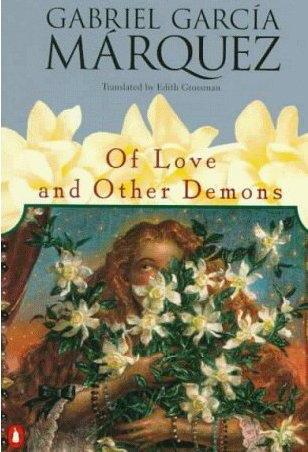
Of Love and Other Demons, Gabriel Garcia Marquez
This was an interesting book. I had previously read "Love in the Time of Cholera" by the same author and really enjoyed it, so I picked up this little story at the library a few weeks ago. I really enjoy Marquez's writing style. He has a way of wording things that I really like. Of course, it is translated from Spanish, so who knows if it is exactly as the author intended it. At the same time, however, I think it is impressive that a translator could get the author's meaning across so eloquently. This book was the story of a family that was part of the decaying noble class in 18th century Colombia (I think - ? I guess it never really says exactly where the book takes place but Marquez is from Colombia and the other book I read was set there, and this setting seemed similar). Don Ygnacio de Alfaro y Duenas is the father of this family, and he is described as a funereal, effeminate man, as pale as a lily because the bats drained his blood while he slept." Bernarda, his estranged wife, loves no one, even her family members, as she pines for a slave that she fell in love with long ago during her days as a merchant in the slave trade. Their daughter, Sierva Maria, is completely neglected by both parents and raised by the household slaves in their African traditions. The girl is bitten by a rabid dog on her twelfth birthday and begins to exhibit bizarre behavior. Or rather, her parents begin noticing her regular behavior when they pay attention to her for the first time. Ygnacio realizes that he actually loves his daughter, and seeks help from the local Catholic bishop, and also a local Jewish doctor, considered to be a heretic. Sierva Maria is eventually deposited by her father into a convent of Clarissan nuns, where she is kept in a prison cell. The bishop finally turns the girl's care over to his protege, Cayetano Delaura, who begins visiting the girl daily. He eventually falls in love with her, and a tragic chain of events is set in motion, including exorcism of the demons believed to be possessing the young girl, and the subsequent deaths of most of the main characters. This time I was expecting tragedy, and I was fine with it in this book. It seemed in keeping with Marquez's writing style. So does a grown man falling in love, or having a physical relationship, with a young girl. This has happened in both of his books that I have read so far. I don't know if this was cultually and morally acceptable in 18th and 19th century South America, or just something the author adds for interest, but it is a little disturbing according to today's standards. Still, an interesting look at the culture of the time and the interplay of science and religion in the society. And at only 147 pages, definitely worth a read.
Tuesday, June 1, 2010
It's over

My show is over. Now, I've never been a big TV watcher, and I especially don't like to plan my life around a show, but Lost sucked me right in and I was hooked. I admit, I joined in late. Adam and Kim let us borrow the DVDs for the first two seasons a couple of years ago. Once I watched those, I knew I had to catch up before the next season (#5) started on TV. Then Chase and I made a Wednesday night ritual of watching the newest episode (we watched them online the day after they came out on TV since we don't get TV channels). It was almost comforting to tune in to those people and their crazy island problems every week! Not to mention, it has got to be one of the best TV shows ever made. Lost was an intelligent show, and assumed the viewer was intelligent as well, which was refreshing. I liked the psychological, philosophical, religious, and literary overtones, and the symbolism. It was a show really made you care about the characters, and what was happening in their lives, past and present (and future!). I even liked the finale. I know some people were disappointed, but I felt like it was emotionally satisfying. I know there were questions that were left unanswered, but I felt like that was to be expected. I think one mark of good writing and character development, whether in a movie, TV show, or book, is that it keeps you thinking about the story long after you have finished it. Lost definitely did that for me. Good thing Netflix has all the seasons on instant play...I just might watch them again! What did some of you other Lost fans think of the series finale? Are you lost without it? (he he)
Weekend
Sleeping in. Picnic in the park. Cookie bites from Corner Bakery. Friends over, and grilled pizza on the barbecue. Settlers of Catan. Sunshine. Naps. Getting sent home from work early. Trail running. Movies. It was a good weekend.
Thursday, May 6, 2010
Food Revolution

Chase and I watched all six episodes of "Jamie Oliver's Food Revolution" on ABC's website. (I love ABC's website! They have all the episodes of all their shows, not just the last 5.) You can watch it here, and I would suggest that you do, if you haven't already. I think there is a lot that we can all learn from it. Everyone has probably heard a lot lately about the movement toward eating more healthy, fresh, and local food and generally having more interest and knowledge in where our food comes from. I have personally been obsessed with this lately, with Netflix helping to feed my addiction by offering streaming documentaries like Food, Inc., King Corn, and of course the old standby, that arguably started it all, Supersize Me.
Anyway, Jamie Oliver, of Naked Chef fame, heard about the US government health report that exposed Huntington, West Virginia as the unhealthiest city in the US, in terms of obesity and related health problems. He travels there to see if he can help the citizens of the town to make some changes. He works with the local schools, churches, and even individual families to educate them about healthy eating and lifestyle choices. Most of his time is probably spent in the community's public schools, trying to exchange the frozen, processed, saturated-fat laden unhealthy foods being served in the schools for fresh-cooked, healthier options. Nearly everyone in the town is opposed to him at first, but as he works with people and shows them how easy and worthwhile the changes can be, he slowly gains many followers.
I won't tell the whole story here, because I don't want to spoil it for those who still want to watch it (please watch!), but I will mention some of the things I found interesting. First, Jamie wanted to see how much the children in the elementary school really knew about healthy eating. He visited a classroom of young children (kindergarten or first grade) and showed them a variety of fresh vegetables. There was not one child in that entire class who knew a single vegetable by name upon seeing it. I don't think most of them had even eaten a fresh vegetable before. And these were not all obscure vegetables either - they were potatoes, tomatoes, and such!
Another thing that I couldn't believe was the "nutritional" guidelines that Jamie and the school were required to follow. In one episode, Jamie cooked his own fresh food for lunch at the high school, instead of letting the kids go through the regular hamburger/chicken patty/french fry line. After serving food for a while, the woman in charge of school lunches for the district showed up and told Jamie that his lunch, which was a vegetable-pasta stir fry with seven different vegetables, and a side of fruit, did not meet the fruit/veggie requirements of the USDA for school lunches. So the french fries were brought back out, as those would fulfill the vegetable requirement. What's crazy is that the USDA and US government guidelines are making school lunches unhealthier than they need to be!
Finally, Jamie went to the home of a local family to see if he could help them learn to make choices that would curb their obesity problem. He went through their kitchen and dumped out all the food from their pantry, fridge, and freezer onto the table. By the time he was done, the table was filled with frozen pizzas, corn dogs, donuts, snack cakes, etc. All of it was processed, pre-packaged food - not one thing was fresh! Needless to say, every member of the family was overweight.
This just backs up my feeling that we each need to be more personally responsible for finding out more about where our food comes from. Is our meat industrially raised, crammed into unlivable spaces and injected with hormones and antibiotics and other additives just to make it "safe" for us to eat? Is our produce shipped in from other countries, contributing to massive carbon emissions and other problems that destroy the environment? It shouldn't be that hard, no matter where we live, to find at least some locally grown, in season produce, or locally packaged foods when we do need to buy packaged. Also, we can take a little extra time to make things that we would normally buy, and it is so much healthier! Making the change to foods that are healthier for us and healthier for the world around us can seem like a difficult task, but let's start small. I challenge anyone who is reading this to watch this show, and make some changes in your family's food choices today!
Also, if you feel strongly about this food issue and you want to help improve school food in America, you can go here to sign a petition that Jamie will eventually be taking to the White House to ask for the government's help in providing more nutritious food in US schools. There are at least 1,000 people from every state that have already signed up!
Wednesday, May 5, 2010
April Book Reviews

The Poisonwood Bible, by Barbara Kingsolver
This book ended up being one of my favorite books that I have ever read. There were just so many things I loved about it - the characters, comprising a family of all girls, the true historical setting (although the book itself was fiction), the wordplay used by the characters and the changing narrator. "The Poisonwood Bible" is set mostly in the Congo (Belgian), Africa in the 1960s. It tells the story of a Baptist preacher and his family who travel to the Congo on an evangelical mission. The story is alternately narrated by the mother and the four daughters of the family. Each has a startlingly astute point of view, whether she realizes it or not. In the backdrop of the family's saga are the true events of the Congo's fight for independence from Belgium, the election of their first democratic leader, and his subsequent assassination as part of a coup backed by the CIA and the American government. I was shocked to read about this. Maybe I should have already known this important story, but I guess it's not the kind of thing they teach you in high school American history. It was a sad commentary on the effects of powerful, first-world nations, and the devastating repercussions faced by developing countries, especially resource-rich ones like the Congo. I would definitely recommend this book to anyone. Five stars.

The Last Summer (of you and me), by Ann Brashares
This book was a nice easy read. It would have been perfect summer beach or camping reading. However, Chase and I had just made a trip to the DI for some old-looking books to help fill our built in shelves in the living room. I saw this one for a dollar, and having read the "Sisterhood of the Traveling Pants" series by the same author, thought I'd give it a try. The back of the book says that this is Ann Brashares's first novel for adults. I'm not sure I'd say it's for adults, but I guess it's not for teenagers. It's about two sisters, Riley and Alice, who have spent their summers for their entire lives on Fire Island, a small island off the coast of New York. Riley and Alice are three years apart in age and very different, yet very close. They have shared many things, including the friendship of their next-door-neighbor on the island, Paul. The summer that the book takes place, Alice and Riley are both in their early twenties and they are spending what they both know may be their last summer on the island. Paul returns to the island that summer too, after being away from the girls for 3 years. Riley hasn't lost any of her childhood wonder, energy, or innocence, but Alice, the younger sister has grown up a bit and is confronted with the realization that she has always loved Paul. The two are faced with how to deal with their new found romance in the presence of Riley, who has always been best friends with Paul. The story follows the three through the summer, the fall, winter and spring of the next year, and into the next summer as they deal with growing up, loss, and love. (No, I didn't copy that off the back off the book, but it sounded kinda cheesy, didn't it?) The story was okay. I do think Ann Brashares has a talent for developing the deep feelings and inner musings of her characters, which I enjoy. This was a fun read that you can easily get through in a day or two. Not amazing though. Three stars.

'Tis, by Frank McCourt
This was another DI find. I haven't read his best-selling memoir, "Angela's Ashes" (not sure why - just haven't gotten around to it I guess), but I couldn't resist this "sequel" memoir by Frank McCourt for 2 dollars. Frank McCourt was born to an Irish family in Brooklyn in 1930. When Frank was four years old, his parents moved with him and their other children back to Limerick, Ireland, where his mother was from as his father was unable to find work in Depression-era America. His eventually found work in England when Frank was older, although he spent most of his earnings on alcohol, rarely sending any to support the family and forcing them into poverty and begging for food and other necessities. When Frank was 18, he returned to American by himself, joined the army, received an education at NYU, and became a high-school teacher and Pulitzer-prize winning author. He himself lived in poverty for many of the years he was in New York, subsisting on his meager teacher's salary and sending any extra money home to Ireland to support his mother and brothers. One by one, each of his family members made their way to America, with the exception of his father, with whom he never really reconciled. "'Tis" tells the story of Frank's adult life against the backdrop of mid-century America. I guess I was surprised to learn that even that recently in our country's history, so many immigrants were being treated differently. Not always badly, but sometimes. McCourt notes many times throughout the book that he wonders why anyone he meets who is Irish and can tell that he is Irish automatically tells him what part of Ireland their parents grew up in, and not to mingle with others who are not like him. Even those who are not Irish among the Americans he meets tell him he's better off sticking with other Irish people. "Stick with your own kind", they tell him. I of course realized that blacks and many other ethnic groups faced and still do face this kind of racism and discrimination, but it was sort of new to me to think of Irish (white people!) as being treated so differently in America, and so recently. Ultimately, though, I think McCourt's "Irishness" very profoundly shaped who he became. This was a sad and also funny and moving true story. Four stars.
Friday, April 23, 2010
Happy Earth Day!

Okay, I know it was yesterday. I didn't have time to post yesterday. But I still wanted to do a post on the 40th anniversary of Earth Day! I think it's great that since 1970, Earth Day has become more accepted and more mainstream. And hopefully, living in an Earth-friendly manner is something we're all considering more and more. I wanted to list a few easy things that we can all do, and that we try to do at our house, to live a more sustainable lifestyle.
1. Use less plastic. Reusable shopping bags are a great start. Plus, they are much cuter than plastic grocery bags. You can get some great-looking ones at Envirosax. They even come in a little case so you can throw them all in your glove box when you're driving to the store. And speaking of driving to the store...
2. Drive less! Combine trips if you can, and ride the bus or the train! Lots of times when I ride the bus, I am the only one on it. If we could fill up the buses, we'd take a lot of cars off the road!
3. Use less power. Unplug your phone charger when it's not actually charging your phone. Plug your TV, DVD player, etc. into power strips that you can turn off when you're not using them. Get dimmer switches for your room lights, and use CFLs. But dispose of them properly!
4. RECYCLE! This one is easy! We put so much less garbage in our landfills when we recyle.
5. Use less water by implementing strategies like using a shower timer to take shorter showers, or turning off the water while you're brushing your teeth. (I'm still working on these ones.)
6. Grow your own food. Plant a garden and get as much food out of your own yard as you can! The only energy used in producing and harvesting will be the calories you burn working in the garden and picking your home grown fruits and vegetables!
These are just a few things that are easy to add into your daily life...I may add more if I think of them. What things do you do?
Sunday, April 18, 2010
March Book Reviews
I didn't get as much reading done as I was hoping in March. I did manage to get through two short books though. So I'm a little late in posting them, but here they are.

"Their Eyes Were Watching God" by Zora Neale Hurston was the first book I read in March. It is a novel that is considered the author's greatest work. Zora Neale Hurston was an African American author in the early 20th century. I would actually like to read more of her books, as she was a compelling and stimulating author, who also seems like a very interesting woman. And, Zora is a really cool name. This books is about a young African American girl who has grown up in the South, experiencing the many prejudices faced by blacks and women at that time. Refusing to fit into the mold that society has cast for her, the story follows Janie into adulthood through three marriages (one arranged) and shows how she finds love on her own terms. The story takes place primarily in Eatonville, Florida, the first all-black incorporated town. As someone who was born and grew up after civil rights were in place it seemed like a great glimpse for me into the life of African Americans in the early 20th century. Five stars.

I've had "Jonathan Livingston Seagull" on my shelf for probably at least ten years. I think I had to buy it for a college class once, but then I don't think we ever ended up using it for the class. At any rate, this was the first time I read it. It was a nice inspirational story, I suppose, and it had a good message about working hard to become your best self and help others. I found it a little hokey, though. Maybe it was the grainy black-and-white photos of seagulls throughout the book, or the corny 1970s feel to the story and the personification of seagulls with dignified sounding human names (and middle names!), but it just didn't quite do it for me. It only took me about an hour to read though, so I wouldn't say it was a waste of time. I can only wonder what the film version is like...two stars.

"Their Eyes Were Watching God" by Zora Neale Hurston was the first book I read in March. It is a novel that is considered the author's greatest work. Zora Neale Hurston was an African American author in the early 20th century. I would actually like to read more of her books, as she was a compelling and stimulating author, who also seems like a very interesting woman. And, Zora is a really cool name. This books is about a young African American girl who has grown up in the South, experiencing the many prejudices faced by blacks and women at that time. Refusing to fit into the mold that society has cast for her, the story follows Janie into adulthood through three marriages (one arranged) and shows how she finds love on her own terms. The story takes place primarily in Eatonville, Florida, the first all-black incorporated town. As someone who was born and grew up after civil rights were in place it seemed like a great glimpse for me into the life of African Americans in the early 20th century. Five stars.

I've had "Jonathan Livingston Seagull" on my shelf for probably at least ten years. I think I had to buy it for a college class once, but then I don't think we ever ended up using it for the class. At any rate, this was the first time I read it. It was a nice inspirational story, I suppose, and it had a good message about working hard to become your best self and help others. I found it a little hokey, though. Maybe it was the grainy black-and-white photos of seagulls throughout the book, or the corny 1970s feel to the story and the personification of seagulls with dignified sounding human names (and middle names!), but it just didn't quite do it for me. It only took me about an hour to read though, so I wouldn't say it was a waste of time. I can only wonder what the film version is like...two stars.
Subscribe to:
Posts (Atom)